
Does RF Microneedling Melt Facial Fat? The science behind heat, depth, device design—and why not all RF microneedling is the same.
If you've spent five minutes researching RF microneedling lately, you've probably encountered some version of:
“Don't do RF microneedling. It melts the fat in your face.”
It's a frightening statement—especially when maintaining facial volume is one of the things that helps a face look youthful.
But there's an important distinction between a possible complication and the intended mechanism of a properly selected and appropriately performed treatment.
In October 2025, the FDA issued a safety communication after receiving reports of serious complications associated with certain uses of radiofrequency microneedling, including burns, scarring, nerve damage, disfigurement and fat loss. The FDA continues to evaluate the issue.
So yes: unwanted fat loss has been reported.
No: that does not mean every RF microneedling treatment—or every RF microneedling device—is designed to “melt fat.”
To understand the difference, we have to stop talking in social-media sound bites and start talking about anatomy, physics and energy delivery.
Welcome to Ethos Education.
First: What Is RF Microneedling Actually Doing?
Traditional microneedling creates controlled mechanical microinjuries in the skin. Those injuries initiate wound-healing and remodeling processes.
RF microneedling adds another variable: radiofrequency energy.
The needles enter the tissue and act as electrodes, allowing RF energy to generate localized heat at selected depths. The goal in facial rejuvenation is generally controlled thermal injury within targeted tissue, producing remodeling effects while limiting unnecessary injury to surrounding structures. The FDA describes RF microneedling similarly: microneedles allow RF energy to reach specific depths within or under the skin, where local heating produces tissue changes.
That means an RF microneedling treatment isn't simply:
Needles + heat = collagen.
It's closer to:
Needle depth + energy + pulse characteristics + tissue impedance + needle configuration + anatomy + technique = biological response.
And that's where this conversation gets interesting.
So…Can RF Affect Fat?
Yes. Radiofrequency energy can affect adipose tissue under appropriate conditions.
That isn't controversial.
RF technologies have actually been investigated specifically for adipose reduction. A systematic review examining RF and adipose tissue found evidence suggesting effects on adipocytes and lipolysis, although the studies varied considerably and overall methodological quality was limited.
But here's the distinction that gets lost online:
The presence of radiofrequency energy does not automatically equal fat destruction.
Where the energy is deposited matters.
How much energy is delivered matters.
How long the tissue is heated matters.
The depth matters.
The device matters.
And most importantly:
The anatomy matters.
Your dermis and your subcutaneous fat are not the same tissue compartment.
If our objective is dermal remodeling, we want our treatment parameters appropriately selected for the tissue we're actually trying to affect.
Think TARGET, Not Temperature
This may be the most important concept in this entire article.
With RF microneedling, more energy is not automatically better.
Deeper is not automatically better.
Hotter is not automatically better.
More aggressive is not automatically better.
The goal isn't to see how much injury the skin can tolerate.
The goal is to create an appropriate biological response in the appropriate tissue.
That distinction matters tremendously on the face, because facial anatomy changes from region to region. Skin thickness varies. Fat compartments vary. Important nerves and other structures occupy different planes.
A treatment parameter appropriate for one area isn't automatically appropriate for another.
That is why at Ethos, we don't believe RF microneedling should ever be treated like a paint roller:
Same depth. Same energy. Same number of passes. Everywhere.
That's not personalization.
That's a preset.
Insulated vs. Non-Insulated Needles: This Matters
Here's where we're going full skin scientist.
RF microneedling devices don't all deliver energy in exactly the same way.
One important difference is whether the needles are insulated or non-insulated.
With an insulated needle, most of the shaft is electrically insulated and energy is concentrated around an exposed portion—often near the tip. With non-insulated needles, the needle itself can function as an active electrode along a greater portion of its length.
A review of fractional microneedle RF physics describes this distinction and notes that insulation can allow RF energy to be delivered at a more specific dermal depth while limiting thermal injury along the insertion pathway.
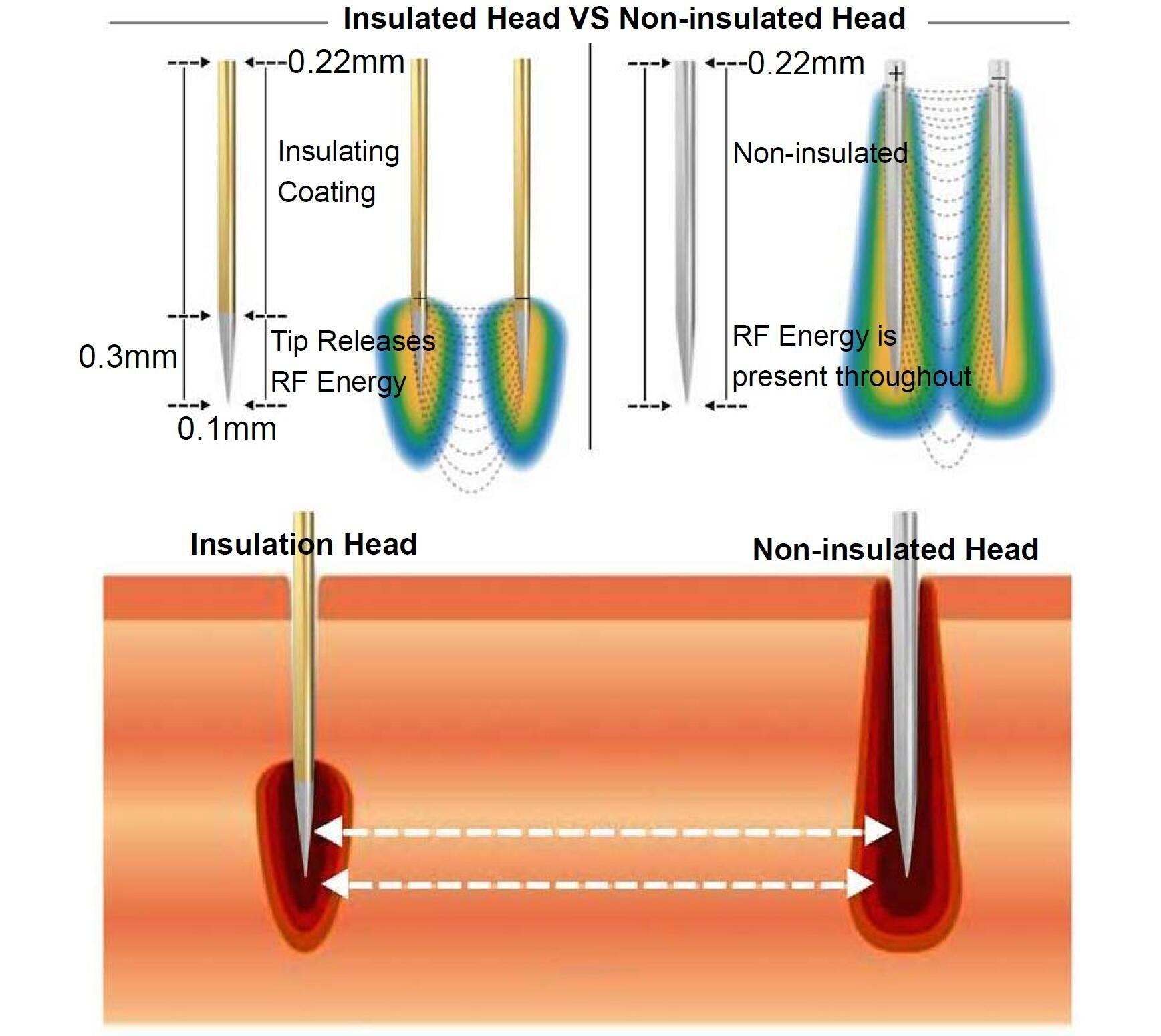
That doesn't mean one needle design is universally “good” and another universally “bad.”
It means they behave differently.
And that's exactly why lumping every RF microneedling device into one category and expecting identical tissue effects doesn't make scientific sense.
But Didn't the FDA Warn About RF Microneedling?
Yes—and patients deserve to know that.
On October 15, 2025, the FDA announced that it had received reports of serious complications associated with certain uses of RF microneedling, including:
burns
scarring
fat loss
disfigurement
nerve damage
injuries requiring medical or surgical intervention
The FDA also explicitly describes RF microneedling as a medical procedure, recommends seeking a licensed healthcare provider with training and experience using RF microneedling devices, and recommends asking which device will be used.
We think that's good advice.
Safety information shouldn't scare patients away from technology.
It should make patients better consumers of technology.
Here's Where the Evidence Gets Really Interesting
The FDA's adverse-event reports need to be taken seriously.
But they also need to be considered alongside the clinical literature.
A 2026 systematic review examined 20 RF microneedling studies encompassing 558 participants. The review reported improvements in skin texture and tightening, while the adverse effects reported in those studies were predominantly temporary redness and swelling. Importantly, no serious complications were reported in the studies included in that review.
The authors specifically acknowledged the FDA advisory and noted that treatment depths in the reviewed studies were largely intradermal and that fat necrosis was not observed in those studies. They also cautioned about limitations in the published literature, including likely publication bias.
That doesn't invalidate the FDA reports.
And the FDA reports don't invalidate the clinical studies.
Together, they tell us something far more useful:
Technique matters. Parameters matter. Tissue depth matters. Patient selection matters.
That's a much more scientifically responsible conclusion than either:
“RF microneedling melts fat.”
or
“RF microneedling can never cause fat loss.”
Neither statement adequately reflects what we currently know.
Why Can Two People Have Completely Different RF Experiences?
Because RF microneedling isn't one treatment.
There are different devices.
Different needle configurations.
Different depths.
Different energy settings.
Different pulse characteristics.
Different numbers of passes.
Different treatment patterns.
Different anatomical areas.
And different patients.
A 2026 systematic review spanning multiple dermatologic indications specifically noted the heterogeneity among RF microneedling devices and treatment approaches.
This is something we talk about constantly at Ethos:
Technology doesn't replace education. It makes education more important.
Buying an advanced device doesn't automatically create an advanced provider.
Understanding why you're choosing a particular depth, energy level and treatment pattern is just as important as knowing which button activates the device.
What Should You Ask Before RF Microneedling?
Don't simply ask:
“Do you offer RF microneedling?”
Ask:
What device are you using?
Why did you choose this device?
Are its needles insulated or non-insulated?
How do you determine treatment depth in different areas of my face?
How do my facial anatomy and existing volume affect your treatment plan?
What endpoint are you trying to create?
How do you adjust parameters for thinner versus thicker treatment areas?
What are the potential complications—including unwanted fat loss?
A knowledgeable provider should be comfortable discussing those questions.
You aren't being difficult.
You're asking someone to explain what they're doing to your tissue.
We think that's completely reasonable.
At Ethos, We're Not Trying to “Max Out” Your Treatment
Our philosophy has never been more is more.
Our philosophy is:
The right treatment. The right tissue. The right patient. The right parameters.
Sometimes that means RF microneedling.
Sometimes traditional microneedling makes more sense.
Sometimes IPL belongs in the treatment plan.
Sometimes regenerative treatments make sense.
Sometimes the smartest thing we can do is leave something alone.
Because great aesthetics isn't about performing the most aggressive treatment your skin can survive.
It's about creating enough stimulus to achieve the desired response while respecting the anatomy and biology we're working with.
That's precision.
The Ethos Bottom Line: Does RF Microneedling Melt Fat?
Here's the scientifically responsible answer:
Unwanted fat loss is a documented reported complication of certain RF microneedling uses. The FDA has explicitly warned patients and providers about it.
At the same time, fat loss is not an inevitable consequence of RF microneedling, and a recent systematic review of facial rejuvenation studies did not report fat necrosis in the included clinical studies, which largely used intradermal treatment depths.
The better question isn't:
“Does RF microneedling melt fat?”
It's:
“Where is the energy going, how is it being delivered, and does the person holding the device understand the tissue they're treating?”
That's the conversation patients deserve.
Because when we're working with your face, physics matters. Anatomy matters. Education matters.
And at Ethos, they always will.
Final Thought
Aesthetic medicine doesn't need more fear.
And it doesn't need more hype.
It needs better education.
We believe patients should understand not only what treatment they're receiving—but why it works, what the risks are, and why their treatment plan was chosen specifically for them.
Science. Precision. Skin that lasts.
— Ethos Med Spa | Monona + Madison, Wisconsin
