
Exosomes: What They Are, How They Work, and What We Still Don’t Know. Separating science from hype in regenerative aesthetics
Exosomes have quickly become one of the most talked-about topics in regenerative aesthetics. They’re often described as “next-level healing,” “cellular communication,” or even “liquid gold.”
But with that excitement comes confusion.
At Ethos Med Spa, we believe innovation should always be paired with education. So for National Exosome Day, let’s break this down at a deeper level:
✨ What exosomes actually are
✨ How they function biologically
✨ Where the science is strong—and where it’s still evolving
What Are Exosomes—Scientifically?
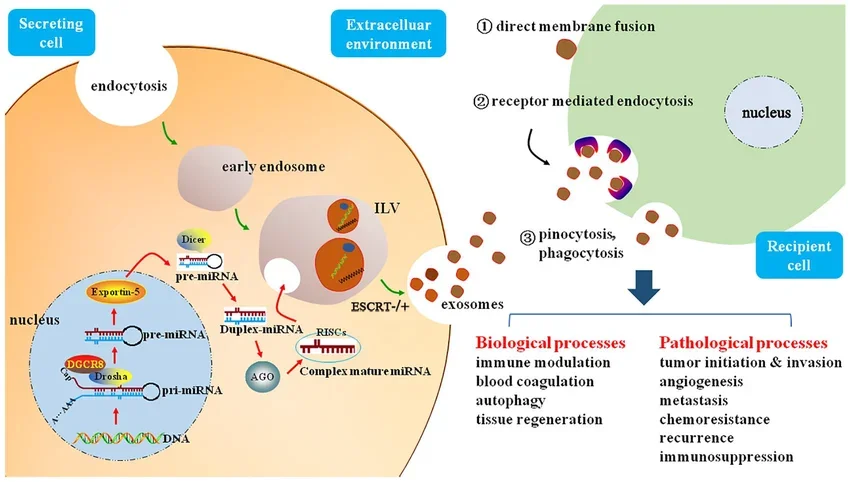
Exosomes are extracellular vesicles (EVs)—nano-sized lipid bilayer particles released by cells.
They function as intercellular communication vehicles, carrying:
Proteins
Lipids
Messenger RNA (mRNA)
MicroRNA (miRNA)
Signaling molecules
Their role is not to “become” new tissue, but to influence how existing cells behave.
Think of them less as building blocks—and more as biological messengers.
Exosomes have quickly become one of the most talked-about topics in regenerative aesthetics. They’re often described as “next-level healing,” “cellular communication,” or even “liquid gold.”
But with that excitement comes confusion.
At Ethos Med Spa, we believe innovation should always be paired with education. So for National Exosome Day, let’s break this down at a deeper level:
✨ What exosomes actually are
✨ How they function biologically
✨ Where the science is strong—and where it’s still evolving
What Are Exosomes—Scientifically?
Exosomes are extracellular vesicles (EVs)—nano-sized lipid bilayer particles released by cells.
They function as intercellular communication vehicles, carrying:
Proteins
Lipids
Messenger RNA (mRNA)
MicroRNA (miRNA)
Signaling molecules
Their role is not to “become” new tissue, but to influence how existing cells behave.
Think of them less as building blocks—and more as biological messengers.
What the Current Research Supports
There is promising and growing research showing that exosomes may:
Support wound healing
Influence inflammatory pathways
Enhance cellular communication
Improve tissue recovery environments
These findings are especially relevant in:
Dermatology
Wound care
Regenerative medicine research
However, it’s important to note:
Many studies are still preclinical or early-stage clinical.
What We Still Don’t Fully Know
This is where responsible providers pause—and educate.
Current limitations include:
Lack of long-term, large-scale human studies
Variability in product quality across the market
Inconsistent standardization of exosome formulations
Regulatory ambiguity in aesthetic use
This doesn’t mean exosomes don’t work.
It means we are still learning how to use them optimally and safely.
Why Education Matters in Regenerative Aesthetics
Exosomes are exciting—but they’re also a perfect example of how quickly innovation can outpace understanding.
Without proper education, they risk being:
Over-promised
Misrepresented
Used without full comprehension of mechanisms
At Ethos, we believe:
✨ Curiosity is good
✨ Innovation is exciting
✨ But understanding is essential
The Ethos Perspective
We approach exosomes with:
Scientific curiosity
Clinical caution
Respect for evolving research
Commitment to patient safety
We use regenerative tools as part of a broader strategy, not a standalone miracle.
Because skin doesn’t respond to hype—it responds to biology, consistency, and intelligent care.
Final Thought
Exosomes represent a fascinating step forward in regenerative medicine—not because they replace tissue, but because they help coordinate the body’s natural repair processes.
They are not magic.
They are not a shortcut.
They are a tool—one we are still learning to fully understand.
And in modern aesthetics, that’s exactly where innovation should live:
✨ At the intersection of excitement and evidence ✨
